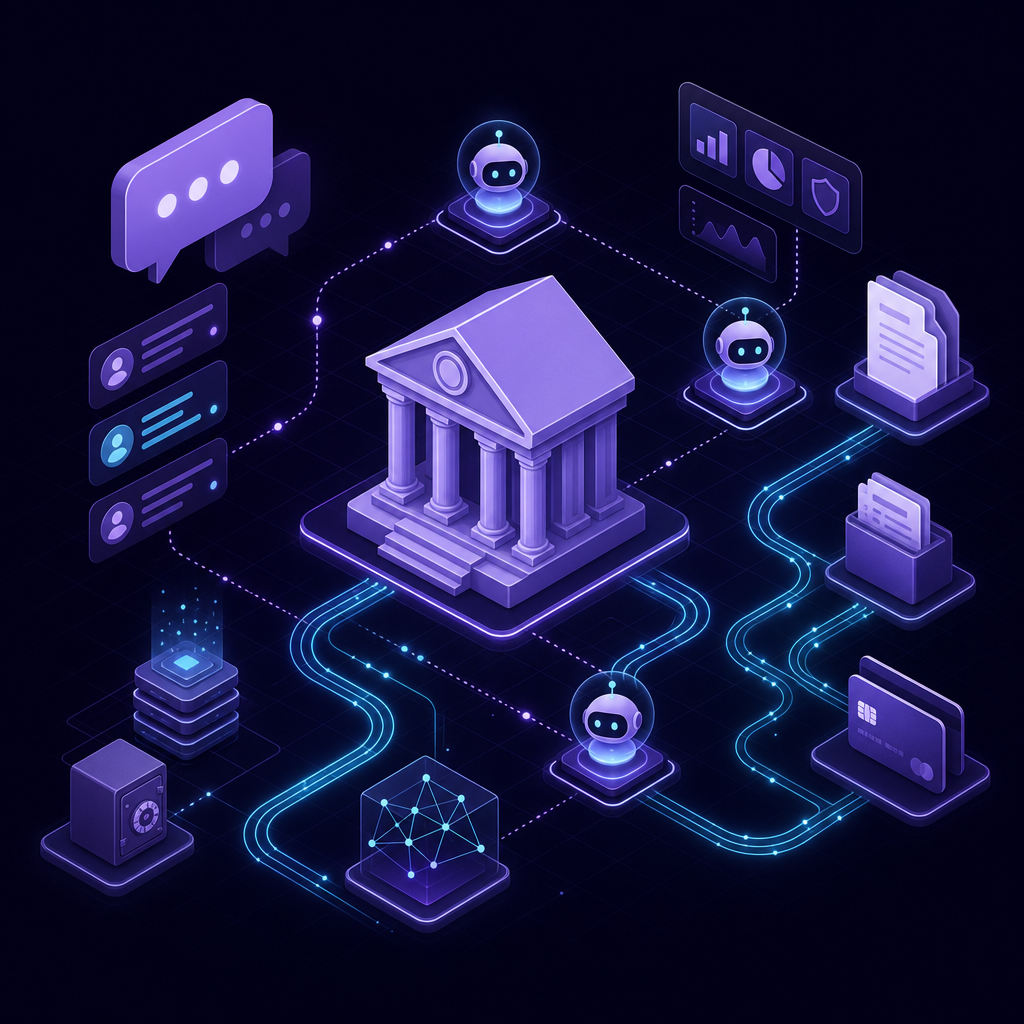
With the proliferation of Conversational AI, Generative AI and Agentic AI into almost every walk of human life, I wanted to explore how this can be — and is being — leveraged in different industries.
Morgan Stanley is leveraging Generative AI (GPT-4) to power an internal-facing chatbot that performs a comprehensive search of wealth management content — essentially giving wealth managers the knowledge of the most knowledgeable person in the firm, instantly.
In this article, I cover how Generative AI can be leveraged across banking operations. Several dimensions shape these functions — the geographical regions where a bank operates, the types of customers (individuals, businesses), products offered, and scale of operations. While not exhaustive, this covers a broad spectrum of common banking-operation functions.
/01Account opening & maintenance
This involves the process of opening various types of bank accounts (e.g., savings, checking) and maintaining customer information and records.
Intelligent chatbots can engage with potential customers to collect the necessary information and guide them through a personalized self-serve account opening process. During account opening, Generative AI can analyze customer responses and financial profiles to offer personalized product recommendations — savings or investment accounts, credit-card options, or loan products. Generative AI algorithms can also automatically process documents by extracting relevant information from IDs, proof of address and income statements — automating data entry and minimizing errors.
/02Transaction processing
Generative AI algorithms can analyze transaction patterns, origin location, user behavior, historical data and watch-lists to detect potential fraudulent activities in real time. This significantly aids payment investigation analysis at scale — covering a broader dataset, with speed. Customer transactions can be automatically categorized based on spending patterns, giving customers a clear view of their financial habits and helping banks offer personalized advice. Transaction data and cash-flow patterns can also predict future cash-flow needs, helping banks and customers optimize cash-flow management and planning.
Generative AI (GPT-4) is being leveraged at Stripe for fraud detection, among other use cases.
/03Clearing & settlement
Generative AI can efficiently reconcile large volumes of transaction data and accounts — comparing internal records with external sources like clearinghouses and other financial institutions. Transaction data can be automatically matched, and any discrepancies or mismatches identified in real time, drastically reducing manual reconciliation effort.
Transaction data during the clearing and settlement process can also be analyzed to identify potential fraudulent activities. If suspicious transactions are detected, the relevant parties can be notified for investigation. Beyond that, there's an opportunity to optimize settlement routes by analyzing historical settlement data — resulting in faster transactions and lower settlement costs.
/04Cash management
Cash demand at branches and ATMs can be predicted. By analyzing historical transactions and external factors — seasonal trends, events — Generative AI models can estimate future cash requirements accurately. Banks can then optimize cash supply, ensuring the right amount of cash is available at the right time and location, reducing the risk of cash shortages or excess holdings.
Based on real-time transaction data and predictive insights, banks can optimize cash replenishment schedules for ATMs and branches. Generative AI can analyze cash-flow patterns for individuals and businesses and surface trends — letting banks offer targeted financial advice and helping businesses make better working-capital decisions.
/05Compliance & regulatory reporting
Banks continue to face increased regulatory obligations across the world. Understanding these regulations and submitting reports is itself time-consuming and expensive. Generative AI models can scan and summarize regulatory documents, guidelines and updates — processing large volumes and surfacing concise summaries and actionable insights, helping compliance teams understand and implement changes.
That same understanding can automate the monitoring of transactions for regulatory violations, ensuring transactions comply with rules like the Bank Secrecy Act (BSA) and FATCA. By identifying non-compliant activity proactively, banks can take corrective action and avoid penalties. Analyzing customer data, transaction patterns and external sources also helps identify high-risk customers and potential money-laundering activities.
/06Customer service
Banks can deploy virtual assistants across webchat and voice. These handle common inquiries — balance checks, transaction history, general banking information — with natural-language understanding that interprets queries accurately and responds instantly, reducing wait times for human support.
Generative AI can also analyze customer feedback and reviews from social media, surveys and support interactions. Through this sentiment analysis, banks can gauge satisfaction, identify pain points, and personalize service recommendations.
ABN Amro is using the technology to automatically summarize conversations between bank staff and customers — and to help employees gather data on customers to assist with answering queries and avoid repetitive questions.
/07Loan operations
Intelligent virtual assistants can guide customers through the loan application process — making it seamless and fully self-serve. Generative AI models can help gather and validate KYC documentation, providing instant feedback on eligibility and potential loan options. Models can analyze customer data — credit history, income, financial behavior — to assess credit risk and assign appropriate risk scores to applicants.
/08Treasury operations
Generative AI models can analyze market data, economic indicators and historical trends to optimize and suggest investment strategies for the bank's treasury department. Historical currency-exchange data and global market trends can also be analyzed to predict foreign-exchange rate movements, helping banks make informed decisions on hedging and currency trading. Cash-flow data from various sources can be combined to forecast future cash-flow patterns, helping treasury optimize liquidity management and plan for surpluses or deficits.
/09Card operations
Card transaction patterns, location data and spending behavior can be monitored in real time to identify potential instances of card fraud. When suspicious transactions are detected, the system can immediately block the card or trigger alerts for investigation — protecting customers and preventing losses.
Analyzing spending patterns also generates personalized credit-card offers. Models can identify customers likely to be interested in specific card features or rewards programs based on transaction history — tailoring offers, increasing acceptance, and lifting card usage and satisfaction.
/10Collections
Managing overdue loan and credit-card payments — and working with customers on repayment solutions — is critical. Generative AI models can analyze customer data, credit history and financial behavior to create customized repayment plans aligned with each customer's ability to pay. Factors like income, expenses and outstanding debt help surface manageable schedules. The service itself can be made available to collection agents through a virtual agent. Flexible, personalized repayment options improve satisfaction and the likelihood of timely resolution.
/11IT support
Technology is the backbone of every modern bank — making IT, online banking, mobile apps and cybersecurity another critical operation. Generative AI can power internal virtual assistants — chatbots and voice bots — that answer FAQs and handle helpdesk activity: password resets, unlocking accounts, granting access to files or databases. Incident tickets can be automatically categorized by severity and impact, then triaged with recommendations or routed to the right team — streamlining incident management and accelerating resolution.
Generative AI can also help IT teams build initial designs like data models and assist with code generation. These augment skillsets and help teams deliver products faster.